Heavenly Homemakers

Encouraging women in homemaking, healthy eating and parenting

  • Home
    • About
    • FAQs
  • Recipes
    • Bread and Breakfast
    • Condiments
    • Dairy
    • Main Dishes
    • Side Dishes and Snacks
    • Desserts
    • Gluten Free
    • Instant Pot
    • Crock Pot
    • Heavenly Homemaker’s Weekly Menus
  • Homemaking
    • Real Food Sources
  • Store
  • Contact
    • Advertise
    • Disclosure
    • Privacy Policy
  • Simple Meals
  • Club Members!

Guest Post: Healthy Eating for Wimps

August 18, 2009 by Laura 23 Comments

This post may contain affiliate links. For more information, please see our disclosure policy.

I’m so grateful for this guest post from Amy at Finer Things. Not only can I now go spend time finding a shovel so that I can dig out my kitchen and once again have a clean dish to cook with….this post is just so well written and helpful. Thank you Amy! And just so you know…I don’t think you are a wimp.  :)
——————————————–

I’ve learned a lot about healthy eating over the past few years. Mainly, that healthy eating isn’t what I thought it was! While soaking my grains and making my own yogurt and buying everything organic still seems a bit out of reach for me, I am making strides. 

You can, too! Feeling wimpy about your healthy choices? Overwhelmed about a 180°  turn in your eating habits? Here are some of the things I’ve done; painless baby steps if you will.  

  • I make all of our own bread in the bread machine. The machine does the work, then I shape and bake the loaves.
  • I’m gradually increasing the amount of whole wheat in my recipes, rarely making anything with just white flour. We are all adjusting beautifully to the heartier taste and texture of whole wheat, and find it very difficult to eat plain white.
  • We only eat natural peanut butter. That’s an easy fix. It doesn’t cost much more than the partially hydrogenated scary stuff, and it tastes great!
  • I work constantly to reduce the amount of sugar in recipes, especially muffins and sweet breads. Substituting applesauce or mashed bananas for some of the sugar (and oil) works nicely. I also add other fruits to the mix, cutting the sugar nearly in half. We don’t miss it!
  • No more margarine or shortening in my house. It’s all butter here. After I got over the price shock, it was an easy switch. I’ve learned to stock up and freeze butter when it’s on sale.
  • We recently found a farm for our eggs and milk. It completely blechs me out to eat a pale yellow store-bought egg now, and the milk? No more infertility-causing skim milk for us. I had no idea! Did you?!
  • While I still buy the occasional granola bar or box of cereal, those items are stored in our basement “out of site, out of mind.” They are saved for our ballgame bag (can’t be any less healthy than concession stand food!) or spur-of-the-moment road trips.


See? Small changes can lead to healthy strides in your wimpy eating! 

What changes are you ready to make?

Heavenly Homemaker's Club Members: Access your homepage and all your fantastic resources here! Not a member yet? Please join us!

Is Agave Nectar Good For You? Should I Soak my Grains? A Bit of Controversy

August 5, 2009 by Laura 32 Comments

This post may contain affiliate links. For more information, please see our disclosure policy.

We all just want to be healthy and eat healthy, right? (Except for those times we just want to be healthy but eat Cheetos, that is.)

I do quite a bit of research each time I tell you that a certain food is or isn’t good for you. The trouble is that there’s a lot of controversial information out there. 

I know there will always be absolute opposite information about eating butter vs. not eating butter. People creating high fructose corn syrup will try to convince me that their product is “natural” and I will big fat never believe it. But I get SO frustrated about differing information about what I’ve read from sources I’ve believed to be true. (Remember my rapadura vs. sucanat mystery here? I now see that organic sucanat is the same as rapadura even though I originally read and understood that rapadura was better. And sucanat costs less.)

So here are the latest question marks. I bring these up for several reasons:

I think we should all be well informed. I think we all need to eat as healthy as we possibly can. I want to know the truth.  I want you to read it for yourselves. And also I want you to know that I don’t know everything (but you already knew that, right?).

  1. Is agave nectar used as an alternative to sugar good for you?  I thought it was. Because I’d read that it was. And then I read this article from Dr. Mercola. And this article by John Kohler. Shucks. I think I’ll just stick with pure maple syrup instead. 
  2. Is it necessary to soak my grains before making them into bread, pancakes, muffins, etc?  According to my Nourishing Traditions cookbook, soaking grains is a wonderful step to take to break down the phytic acid in grains and make them more digestible. I’ve written a whole post about it encouraging you to do this. BUT according to this article from Bread Beckers, taking this step isn’t necessary. REALLY? I’ve never read any information telling me that it wasn’t necessary!! It’s a long article, but I encourage you to read it. I really don’t know what to think. I have such a hard time wrapping my brain around not soaking my grains. (Thanks Dawn for the emails and links!)

I don’t always take the time to soak my grains, so part of me would love to not feel so bad each time I feed my family “straight” whole wheat. Not to mention the time it would save. On the other hand…I know from experience what my tummy feels like when I eat oats that have not been soaked vs. how my tummy feels when I’ve soaked them. I can tell a digestive difference.

The agave nectar issue isn’t such a dilemma for me. I could take that or leave it since there are so many other healthy and natural sweeteners out there (raw honey, maple syrup, sucanat, stevia). But the soaking grains things has really got me stumped.

I’d love to hear your thoughts and knowledge on these subjects. From your research and learning…What do you know about Agave Nectar? and  What’s your take on soaking grains?

While you’re answering…I think I’ll just go eat a peach. It’s from my own tree and I KNOW it’s good for me.

Heavenly Homemaker's Club Members: Access your homepage and all your fantastic resources here! Not a member yet? Please join us!

Some More Cheesy-ness

March 9, 2009 by Laura 8 Comments

This post may contain affiliate links. For more information, please see our disclosure policy.

I thought I’d take a little time to answer questions from my mozzarella cheese making post:

1. Have you ever found rennet or citric acid at a pharmacy or local store?

No, I haven’t…but I don’t have a lot of options in the smallish town I live in. I have found citric acid at a bulk food store I like to visit on my way to visit family in KS…otherwise…I just rely on my online resources. What in the world did Ma Ingalls do without the world wide web?

2. I’m curious as to what your outcome is in quantity. How many cups of cheese? Cups of whey? …

I usually get about three eight ounce (ish) balls of cheese when I start with two gallons of milk. There is a ton of whey leftover (how many cups are in a ton, do you suppose?). More accurately, I’d say it’s around a gallon, maybe?

3. Can you shred that mozarella to use on pizza and stuff?

Oh yeah! My kids like for me to just cut off hunks of it for them to munch on, but I shred it and put in on our pizza, definitely. It doen’t shred quite as easily or melt quite as well as store bought but it works well enough. It’s kinda string-y…a lot like string cheese. I need to try to make cheese sticks sometime with it!

4. What about cheddar? Can you teach us that one too?

Oh, how I wish I could. Cheddar is a whole-nuther process. It requires (as far as I understand) a cheese press and other equipment…plus it has to age for several months. It’s not nearly as “easy” as mozzarella and I don’t know if I’ll ever be able to learn it. If I do, you’ll be the first to know! For now, I’ll stick with Landmark Raw White Cheddar…it is SO good. (BTW, don’t most of us say whole-nuther, even though it’s not even a word? I think it should be a word.) 

5. Are you an Italian or a Nebraskan? Both?

Actually…neither. (Well, I guess I am an official Nebraskan now)  (Go Huskers!)  Born and raised in Kansas…there’s not a lick of Italian blood in me (as far as I know). Which proves that you (yes, you) also have what it takes to make mozzarella cheese all by yourself. It’s realllllly not that difficult…and it’s realllly cool and fun to try. 

Oh…and it’s also my favorite thing to say to people when they can do something I can’t (like drive a stick shift or answer questions correctly when we play Trivial Pursuit).

“Oh yeah?” I say. “Well I can make mozzarella cheese. Betcha can’t do that? Huh, huh?”

Okay, I don’t really say that. Usually. At least I don’t say it out loud.

Sounds like a whole-nuther issue of mine to deal with doesn’t it?

;)
———————————————-

Heavenly Homemaker's Club Members: Access your homepage and all your fantastic resources here! Not a member yet? Please join us!

Feeding the Family: The Kitchen Tour

January 15, 2009 by Laura 51 Comments

This post may contain affiliate links. For more information, please see our disclosure policy.

Wow, what a great and exciting response to this post, where I promised to take you shopping with me and share more about how I buy food and feed my family a good, wholesome diet on a tight budget!

Over the weekend, I sat down for a couple of hours and put together a list of all the subjects you mentioned either in the comments or by email that you would like to have me cover about Feeding the Family. Here’s a list of the questions from you that I came up with:

  • Where/how do you shop?
  • Where do you buy household products and what do you use?
  • How do you buy in bulk…where/how do you store it/…what about people who have little to no storage space?
  • How did you find a food co-op? What are the options?
  • What is your food budget? How do I figure out which products to buy organically? How do I find good prices for good foods?
  • Share some inexpensive recipe ideas! How about inexpensive healthy snack ideas?
  • Where do you buy your grains? How do you store them? Do you use a variety of grains?
  • Share how you make different kinds of breads.
  • How do you cook to please everyone in my family?
  • How do you go about finding good, local meat, milk, etc.?
  • What are the benefits of organic and/or raw milk?
  • How did you get your husband on board with healthy eating AND spending the extra money for good quality foods?
  • Are you in the kitchen all the time? How do you get all of this done? Is it possible for women who work outside the home to feed their families this way?
  • Tell me more about gardening. What if I only have a small garden space?
  • Where in the world do I begin when I want to make changes toward eating healthier?
  • And…last but not least….I DO want to see your OATS. All 50 pounds of them! What all do you do with them?!

So…those are some of the topics we’ll be covering here over the next few weeks (months?). Far be it from me to keep my bag of oats all to myself.  And…I can’t wait to take my camera over to shoot footage of the cow! 

Before I tell you all kinds of information about how I feed my family I thought I’d take you on a little tour through my kitchen. I figured it might help you understand all the ins and outs of the way I cook if you could first see the kitchen I work in! 

Malachi (my 4 year old) came in during part of the filming of this which makes it SO much more fun to watch than simply hearing my voice and looking at my jars of beans. Also, at one point you’ll hear a big bang in the background where Malachi drops his “kintar” (guitar). 

Now that you’ve been through my kitchen, I can more easily explain the ways we shop, store, cook and eat our food! If you have anything else you would like to see added to the above list…let me know. 

ALSO…so many of you mentioned wanting to know more of my frugal, healthy recipes. I’d love to share more of my recipes with you…but help me out by letting me know what YOUR idea of a frugal amount is? What do you feel like is a reasonable cost PER PERSON per meal?

Heavenly Homemaker's Club Members: Access your homepage and all your fantastic resources here! Not a member yet? Please join us!

Feeding the Family

January 8, 2009 by Laura 44 Comments

This post may contain affiliate links. For more information, please see our disclosure policy.

As Matt and I were working on our 2009 budget…we were looking at all the ways we could try to cut corners…yet there were really no more corners to cut. Yes, our budget has rounded edges. 

And yet…we’re always fine. We always have way more than enough of everything we need. God is so good!!!

If there were more ways to skimp on our budget, we would. But we really do like our kids to be wearing socks without holes and well…running water is such a nice luxury.

There are all kinds of things we choose not to spend our money on. You can read about them here and here.

There is one area of our budget we refuse to skimp:  FOOD. (And yes I know I wrote about this already several months ago…but I keep hearing about people who are chopping their food budgets way down in 2009. I just hope people are cutting it because they spend too much on processed foods and want to buy better food for their buck.)

I used to be a Coupon Queen and a big time food skimper. I compromised the quality of food we ate because I wanted to save money. In the past 3 1/2 years I’ve done a complete turn around and I AM SO THANKFUL. I wrote about it here…please read it if you haven’t already…but it basically says that we NEED to take care of our bodies by eating GOOD NUTRITIOUS FOOD. I wish I could emphasize this more. (You might want to read my whole Getting Real with Food series to learn more about how we eat.)

AND ALSO…can I emphasize how YUMMY wholesome, real food is compared to all of the free or next to free “foods” I was getting with coupons? Not to mention how much better our bodies feel when we eat good food.

I get emails and comments all the time from readers wanting to know how and where I shop and how I am able to afford to feed our family of six so well.   Besides just simply stating that God provides…I came up with an idea that I hope will be fun!

For the next few weeks (or so…until you get bored, and sick of going places with me)…I’m going to take you shopping with me. I’ll take you to the farms where we get our milk and eggs…I’ll introduce you to my cow. (Okay, I don’t have a cow, but there is a particular cow I’m very fond of.)…I’ll take you to my food co-op drop off. I’d take you to the farmer’s market and to my garden…but I can’t because it’s WINTER. :) 

I’ll document for you how much I spend on everything and how we make our food budget work. I’ll share with you how I buy in bulk and how I store my food. 

I’m curious to know how some of you feel about cutting corners in your food budget? While I’m doing this series, what are some specific things you’d like to hear about?  (Like, would you like for me to take a nice picture of my 50 pound bag of oats and do an entire blog post about eating and storing oats? Kidding.)
————————————-

More frugal tips at Biblical Womanhood.

Heavenly Homemaker's Club Members: Access your homepage and all your fantastic resources here! Not a member yet? Please join us!

Such a Sweet Post, Sort Of…**UPDATED!

November 17, 2008 by Laura 28 Comments

This post may contain affiliate links. For more information, please see our disclosure policy.

I’ve told you how much I love Rapadura to bake with. (If you’ve never eaten a brownie made with rapadura…you haven’t had a brownie…well in my chocolate loving opinion…which is just an…opinion.) (Oh dear, now I’m hungry for brownies.)

Rapadura is unbleached, unrefined dehydrated cane sugar juice. It bakes just like sugar (you substitute it one for one)…has a wonderful molasses-y taste and it is SO yummy! Because it is unrefined, it still contains nutrients from the sugar cane.

Many of you have asked if Sucanat is the same thing as Rapadura and if it was just as good for you. I looked at the label of Sucanat…which happens to be named for “SUgar CAne NATural” (very clever), and it appears that Sucanat too is dehydrated sugar cane juice.

I’ll admit to being (more than) a bit confused about Sucanat. It appears to be practically the same as Rapadura…yet my trusty Nourishing Traditions book tells me to avoid Sucanat like I would avoid other processed sugars. It says that Turbinado, Sucanat and Florida Cyrstals “are all refined sugars from which the nutrients have been removed. Small amounts of molasses may be added back to give a light brown color.”

The Sucanat package says that it is “dehydrated whole cane sugar that has not been separated or blended”. THEN, it says that “basically nothing has been added and nothing taken out!”. What does “basically” mean?! Is that something like “Sort of”? Has stuff been added or taken out…or hasn’t it? Oh, I’m so confused.

I googled this subject, researched for way too long and found more confusion. Sigh. Like I need this kind of confusion. I have a hard enough time staying on my feet sometimes.

Here’s what I’ve decided for our family:  I order my Rapadura from Azure Standard. It is cheaper than the organic Sucanat from Azure. I love Rapadura. I’m going to stick with Rapadura.

NONE OF THIS WOULD EVEN MATTER IF BROWNIES WEREN’T SO STINKIN’ YUMMY!!!!

(I’m sorry for yelling.)

What have the rest of you learned about the great Sucanat vs. Rapadura mystery?

**UPDATE**

Valerie commented that I should check out the Weston Price website for information on this. THANK you. (Why did I not think of that before?)  I trust this website. In fact, Sally Fallon, author of Nourishing Traditions bases her nutritional information on Weston Price’s research. Here’s what I found there:

Q. I’m confused as to which type of sugar is better, Sucanat or Rapadura?

A. Both are fine; both are made by dehydrating cane sugar juice. For a while Sucanat changed the way they made it and were using white sugar, so we stopped recommending the product. But they are now making Sucanat the old fashioned way, so we can recommend it again.

Sooo, there you have it. NOW what do you think? :)
—————————————————-

Visit Tammy’s Recipes for more kitchen tips.

Heavenly Homemaker's Club Members: Access your homepage and all your fantastic resources here! Not a member yet? Please join us!

Making Cultured Buttermilk, Kefir and Sour Cream

November 14, 2008 by Laura 189 Comments

This post may contain affiliate links. For more information, please see our disclosure policy.

Wanna know how EASY it is to make cultured buttermilk, kefir and sour cream? Yeah, it takes about 30 seconds of your time. (Don’t tell anyone that though…they think it’s impressive when you make your own.)  :)

The beauty of making your own cultured dairy products is that once you make one batch, you can save the last cup or two to start a new batch. It saves a lot of money to do this, and it is so easy!

I buy my buttermilk, kefir, and sour cream (also known as kreme fresh) starter online. Here are some great starter packet options:

  • Buttermilk and Sour Cream Starter Culture (yep, you can use the same one for both products)
  • Kefir Starter Culture

To Make Kefir:

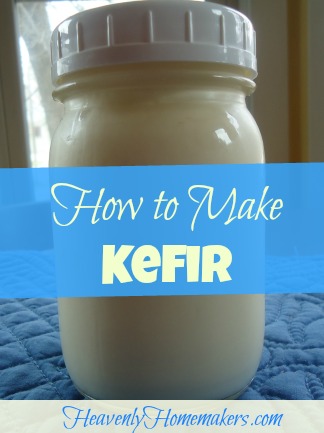
How to Make Kefir

Yum

I begin with just under a half gallon of raw milk in a glass jar. (You can make this with pasturized milk too as far as I know.)  I pour the packet of kefir starter into the milk, shake it up, and put a lid on it. Then, I set the jar in the cabinet above my refrigerator for about 24 hours (in the winter, it takes a little longer in my COLD kitchen!). You’ll know it is done “culturing” when it is thick and has some bubbly looking bubbles all through it. And when you tip your jar over, it kind of…glops. (see how helpful I am?)

To Make Buttermilk:

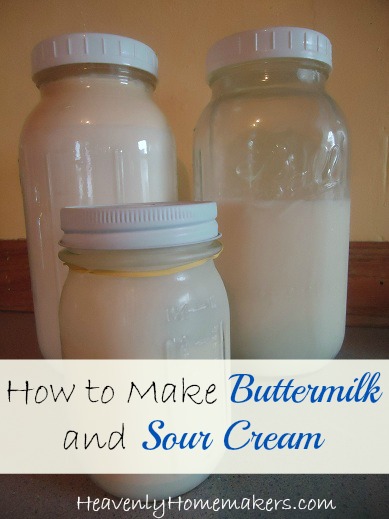
How to Make Buttermilk and Sour Cream

Follow the same instructions as for the Kefir, only use the Buttermilk Culture Starter.

To Make Sour Cream (aka kreme fresh):

Use the Buttermilk Culture Starter with one pint of cream. Follow the same directions as above.

Now, to make more batches of each of these…

Save about a cup each of kefir or buttermilk (or about a third cup of sour cream) from your initial batch.

Use this remaining kefir, buttermilk or sour cream to shake into more raw milk or cream (1/2 gallon of milk…or 1 pint of cream) to begin a fresh batch. Just put it in, shake it up, and let it sit out for 24 hours or so. (Until you’ve got the glop thing going on.)  You can do this up to eight times before you need to begin with a new starter package. (I’ve continued it more than eight times when I’m feeling rebellious. It still works.)

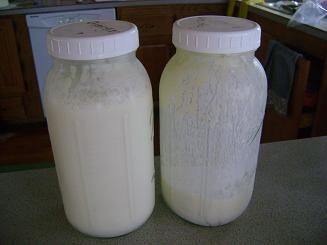
buttermilk1sm.JPG
Here’s the tail end of one jar of buttermilk,
ready to be poured into a fresh 1/2 gallon jar of milk.


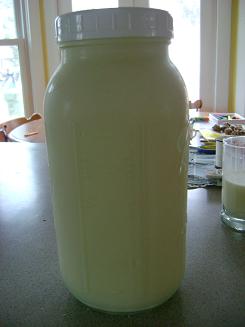
buttermilk2sm.JPG
Here’s a jar of milk with a cup of buttermilk shaken into it,
ready to begin the culturing process.
(Yes, I know it looks like a plain ol’ jar of milk.
You’ll have to humor me and act like you can tell .
Nod and say, oh…very nice.)

buttermilk4sm.JPG
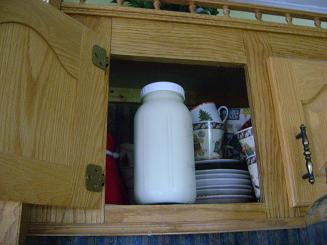
And here is my milk turning into buttermilk in the cabinet above my fridge. (With my Chrismas dishes.)
I’ve been advised that this spot is the best one in my kitchen to culture things because it has a fairly consistent temperature.

Oh, and when I do put my culturing dairy products in this cabinet, I LEAVE THE CABINET DOOR OPEN so that I can see it. It’s a bad idea to forget you have buttermilk or kefir or sour cream culturing in a cabinet. A bad, bad idea.

Now you have really, really healthy kefir for smoothies, and really, really healthy sour cream for your tacos, etc, and really, really healthy buttermilk for drinking or for making Creamy Orange Cooler.

See how easy it is?! :)

Heavenly Homemaker's Club Members: Access your homepage and all your fantastic resources here! Not a member yet? Please join us!

My Favorite Flower…I Mean Flour

October 27, 2008 by Laura 25 Comments

This post may contain affiliate links. For more information, please see our disclosure policy.

I receive lots and lots of emails asking about my whole wheat flour. What kind do I use? Where do I get it? Is it course? Do my recipes turn out heavy from using 100% whole wheat? Do I grind my own  grain? What kind of grain do I use?

I decided to tell you about my whole wheat flour preferences. (Some people have a favorite flower…I have my favorite flour. I’d say my husband has it made.)

My favorite flour is freshly ground from organic white wheat berries. I saved up and bought a “Nutrimill” about three years ago. Definitely one of my favorite kitchen tools. If you’re planning to “go whole wheat” I highly recommend investing in a grain mill so that you can grind your own flour. You will never find whole wheat flour as good as the kind that you grind yourself. IT IS SO GOOD. It is also healthier because it is fresher.

I prefer hard white wheat berries over red wheat berries. There is no nutritional difference…I just find that the white wheat berries make a nicer flour and create nicer, lighter loaves of bread and such. My Nutrimill grinds the flour nice and fine so my flour isn’t course or rough, like some might picture whole wheat flour.

I order my wheat berries from Azure Standard…usually 25 pounds a month. We don’t always go through that many pounds each month…but sometimes we do depending on how much baking I do. (25 pounds may sound like a lot of wheat…but we are a family of six big eaters…and I make everything from scratch. We can easily go through more than one loaf of bread at a time. No wonder I always have flour in my hair.)

If you don’t have a grain mill…I recommend trying to find whole wheat flour made from white wheat berries. I’ve been happy to see the Montana brand of whole wheat flour at my Walmart ground from white wheat. Montana brand is also “chemical free”.

You need to store your flour in the fridge or freezer, especially your freshly ground flour. It has a tendency to go rancid quickly if you don’t.

Occasionally I use soft white wheat berries, instead of hard white wheat berries. (You know, occasionally, like when I accidentally order soft white instead of hard white?)  I prefer hard white berries…but you can grind the soft white berries for making pancakes, waffles and muffins. For making bread, you need to use hard wheat berries.

What else?

Well, this doesn’t have to do with whole wheat flour…but I also use my Nutrimill to grind corn into cornmeal. Makes the best cornbread ever. And I’ve used it occasionally to grind rice when I want to experiment with rice flour just for fun.

What kind of flour do you prefer? Do you have a grain mill? What kind do you recommend? Do you also often have flour in your hair, or is it just me? I personally think it is a lovely accessory.

Heavenly Homemaker's Club Members: Access your homepage and all your fantastic resources here! Not a member yet? Please join us!

Please Pass the High Fructose Corn Syrup

October 13, 2008 by Laura 27 Comments

This post may contain affiliate links. For more information, please see our disclosure policy.

Hey, exciting news! *cough*  Apparently now, instead of saying, “Drink your milk so you’ll grow up to be big and strong like Daddy,”  we can now say, “You may not get up from the table until you’ve finished drinking your Mountain Dew. Now, don’t argue with me. And, you need to eat at least three more bites of that licorice before you can go play. It’s good for you, Dear.”

According to this website that Lindsey told me about (I mentioned it last week and had quite a few questions and comments from you)…High Fructose Corn Syrup is good for us. They say it’s just as natural as eating honey. They say there are no harmful effects from consuming it. 

Who are “they“? They are The Corn Refiners Association. They’ve been hearing quite a bit of negative talk from consumers about HFCS…so they’ve begun taking action so that they don’t lose business. There’s a lot of money in the HFCS realm. And don’t get me started…but money motivation almost always over-rides truth in America. No, seriously. Don’t get me started. ;)

So, please..please will you go read this article by Dr. Mercola? 

Because I’m just a nice mama who enjoys learning and working toward healthy eating and suggests that HFCS isn’t good for you…but Dr. Mercola is…you know….a doctor…and he has actual facts and research to back up what he’s saying. I really appreciated his article explaining more about what we should believe about HFCS. 

What all have you been hearing on this topic? Have you seen the “Pro HFCS” commercial on TV? (I haven’t yet…which is probably a good thing. Yelling at a TV is usually unproductive.)  What’s your opinion on all of this?
——————————————————

Visit Tammy’s Recipes for more kitchen tips!

Heavenly Homemaker's Club Members: Access your homepage and all your fantastic resources here! Not a member yet? Please join us!

Soaking Those Grains…What is THAT about?

September 8, 2008 by Laura 62 Comments

This post may contain affiliate links. For more information, please see our disclosure policy.

I’ve had tons of emails lately asking if I soak my grains and how I do it and why I do it!

Most of the recipes on my site have not shown that I soak my grains. Mostly I did that because I know that many of my readers are just beginning to look into making changes toward healthy eating. I decided…if you are just starting out trying to switch over from fruit roll-ups to real fruit…from white flour to whole wheat…from boxed foods to foods made from scratch…it would be very discouraging to hear that you also should “prepare your grains 12-24 hours ahead of time by soaking them in something that is lacto-fermented in order to break down the phytic acid…”

It’s overwhelming enough sometimes just to try to get your kids to eat a green bean…and to wrap your brain around the fact that almost every food on the shelves that we might be used to eating has a no-no ingredient in it.

So, if you’re just starting out on the healthy eating trail…read over the information in this post and tuck it away for whenever or if ever you’re ready. Continue to take baby steps and make small changes. Read the Getting Real with Food series here to give you some basic ideas of where to start and what to do.

But, if you’re eating a lot of whole grains already and are used to baking from scratch anyway, and you want to take this nutrition thing one step farther…here’s some information for you about soaking grains that I am paraphrasing from Sally Fallon’s book “Nourishing Traditions”:

Eating whole grains is important because they provide vitamin E, B vitamins, many important minerals and fiber. But the phytic acid in the grain combines with the iron, calcium, magnesium, copper and zinc in the intestinal tract, blocking their absorption. They also contain enzyme inhibitors that can interfere with digestion.

So, Nourishing Traditions recommends that we soak our grains in either whey, cultured yogurt, kefir, cultured buttermilk…or in lemon juice or vinegar if you can’t tolerate milk products. Soaking them for at least seven hours allows the enzymes to break down and neutralize the phytic acid. Then, more of the good nutrients in the grain are released and all the good stuff is more readily absorbed in our systems and the grain is digested much more easily.

Okay…so quick re-cap. Eating whole grains is so, so much better for you than processed grains that have almost all of their nutrients stripped from them. Eating whole grains that have been soaked is even better.

How do I do this?

It’s really not hard…I just have to plan ahead a little more. And I don’t always soak everything even though I know I should. I try to just do the best I can. (That’s the goal right?)

So, here’s a quick run down of the basics of how I soak my grains when preparing recipes:

Pancakes and Waffles…I stir the whole wheat flour and the buttermilk together, cover it with a cloth and let it sit overnight. The next day, I add the remaining ingredients and cook the pancakes or waffles. They are SO YUMMY made like this!

Quick Breads and Muffins…I mix the flour with the butter (melted and cooled) or oil that the recipe calls for and add enough buttermilk to make it “soakable”. I let it sit overnight, then mix in the remaining ingredients.

Giant Breakfast Cookies and Breakfast Bars…I mix the melted butter, flour and oats with enough buttermilk to soak then let it sit overnight. I have found these to be VERY HARD to stir the next morning, so putting the soaked mixture into my food processor with the other ingredients so that it doesn’t take me 45 minutes (or until lunchtime) just to stir the silly things. Yea for food processors.

Tortillas…I mix up the tortillas as the recipes says, only I put in 1/4 cup less water and add 1/4 cup yogurt, kefir or buttermilk as I’m making the recipe. Then, I let them sit for the day, and roll them and cook them that night for dinner. They roll out so nicely after they’ve been soaked.

Breads, Rolls and Pretzels…These belong in the “I don’t soak these but I should” category. When I’m really on the ball, I make sourdough bread…but my sourdough starter isn’t starting anymore, so I need to get a new one going. In the meantime, I’m compromising and making Honey Whole Wheat Bread, and that’s okay with me. After I get my sourdough going again, I’ll post about it. Sourdough bread is so tasty!

Cookies and Brownies…I rarely soak these either, mostly because I’m lazy about it. When I do soak them, I mix the butter and flour called for in the recipe with a few tablespoons of buttermilk, kefir or yogurt…allow them to sit for a few hours, then add the remaining ingredients and bake.

I hope that helps. I’ll cover soaking other grains like rice and oats in the future. And, as I slowly but surely get around to it…I’ll go back through each of my site recipes and blog recipes and add a brief explanation of how to soak the grains if you choose to do so. That way, you have the option if you’d like!

And now, I think I’ll go grind me some flour and soak something. Because looking at all these recipes put me in the mood to bake.

(Like I’m ever not in the mood to bake?!)  :)

Heavenly Homemaker's Club Members: Access your homepage and all your fantastic resources here! Not a member yet? Please join us!
« Previous Page
Next Page »

Join Our Community!

 Facebook Twitter E-mail Instagram Pinterest

Popular Posts

~ Will All of the Real Moms Please Stand Up?
~ Easy! Stir-and-Pour Whole Wheat Bread
~ How to Make Gatorade
~ 31 Real Food Breakfast Ideas
~ Dear Teenage Girls...
~ When Mom Takes a Step Back
~ The Inexpensive Health Insurance We Love!
~ Let's Talk Real Food Grocery Budgets

Check out our latest posts!

  • Big Family Food and Fun: May 31-June 6, 2026
  • Big Family Food and Fun: May 24-30, 2026
  • Free 7-Day Summer Menu Plan
  • Big Family Food and Fun: May 17-23, 2026
  • Easy Side Dishes for Summer
Home  ~  Simple Meals  ~  Club Membership  ~  Shop  ~  Privacy Policy  ~  Disclosure  ~ Contact

Copyright © 2026 · Beautiful Pro Theme on Genesis Framework · WordPress · Log in