This is how I keep our big family grocery budget low…

Perhaps when you see our large grocery budget number, you don’t see it as a low number. It’s all relative, right? It is large for a regular-sized family. But for our big family? I think we do a pretty good job of keeping it as low as we can.
So first: Who are we feeding?
- Right now there are 12 people living in our house. But in a few weeks, we’ll be back up to 13 people living in our house – 6 adults, 7 kids. (Our household number fluctuates depending on who is living on our third floor or which of our adult children are living here.)
- Some of the adults in our house grab fast food (on their own dime) from time to time, but in general, we are feeding all 13 people three meals a day.
- All the adults who work outside the home, plus our school-age kids, pack lunches for work/school.
- We have extras at our house for meals frequently. We love getting together with our adult children when we can. Our biggest meal is usually our Sunday Lunch in which we often have around 30 people here including our adult kids plus friends from church. Sometimes people bring food to add to our feast on these days.

Aww, a look at our beloved 19:

We are so grateful to live close to Asa, Eva, and Arrow and Justus, Kelsey, and Little Sweetheart!
What is my projected grocery budget for 2025?
Our budget for 2024 was $1,400/month. You can see the total numbers here sharing what each month looked like. You might notice if you divide my total 2024 spending amount by 12 months that I actually averaged a bit lower per-month amount than I budgeted.
As I look ahead to 2025, I’m looking at how it worked to maintain that budget plus I’m considering these…
- Anna will age out of the WIC program (her benefits gave us about $50/month worth of food).
- Malachi will move back in at the end of January (yay!) so we’re adding one more adult, putting us back up at 13 household members. So with these two changes:
I still plan to keep our grocery budget at $1,400/month right now and see how long that works for us.
I will make adjustments during the year if this doesn’t work or if it is causing stress. Our energy and mental space needs to be used to care for our family and others – not for crunching numbers and worrying over nickels and dimes.

How I Keep our Big Family Grocery Budget Low
I’ve been thinking about all that is working for me as I try to stick to a healthy grocery budget for our household and I came up with a lot of details to share!
After settling into our new Lincoln home and finding my way with new-to-me grocery stores and a new shopping system that works for our needs, this is what I’ve found that works to feed 13 of us with a $1,400/month budget.
1. I always look for meat markdowns.
Buying discounted meat is probably what saves our family the most money on groceries. I settled on this price point for meat, and I am determined to almost never go over. See the exception here.
But with this in mind, I have found that if I look for meat that has been marked down for quick sale – specifically at Aldi, Walmart, or Sam’s – I can almost always buy meat for our family marked down to $2.50/pound or less. This is even less than my price point, and the savings are huge!
These yellow stickers are my favorite! And I’ve found that if I shop in the mornings, that’s when there are the most yellow stickers as the stores clear out their packages of meat that are nearing the “best by” date. I grab them up and freeze them to use as needed. HUGE SAVINGS.

The best mark down I’ve found: for two years in a row, we’ve scored $0.50/pound ham after Christmas. We fill our freezers. One ham goes a long way, even for a large family!

Every once in a while, other stores in town (that I don’t frequent regularly) will offer a big meat sale. If the deals are good, I find it worth it to make an extra stop to take advantage.
2. We shop in bulk.
Having a Sam’s or Costco membership may not pay for itself for some families. But for us? The savings are big and very worth it. I now know which items are priced best at Sam’s, which are best at Costco, and which are better at other stores. Buying large quantities of many of our staples cuts down our cost and is also helpful for my planning needs. It takes a lot of mental pressure off my brain if I know that I have twelve of something in my pantry ready to grab as needed.

It usually takes two carts to get everything we need at Costco or Sam’s each month.
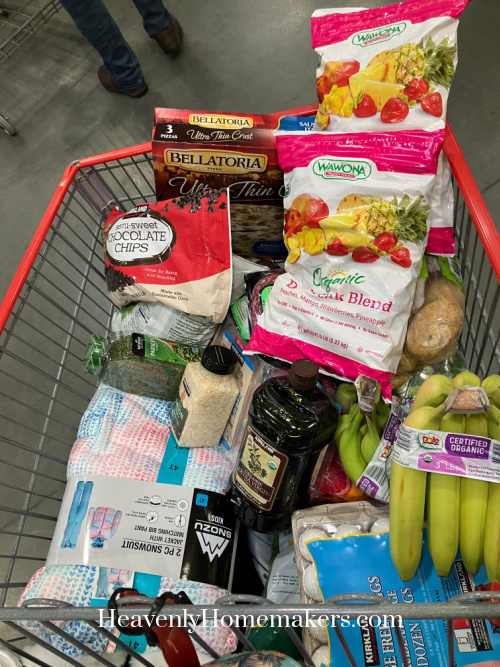
3. I have learned what items are cheapest at which stores.
After living in Lincoln for a year-and-a-half, I’ve learned which prices are best at which store for the products we use and need. My favorite places to shop are Sam’s, Costco, and Aldi with a little Walmart thrown in for those awesome meat markdowns!
Typically, I keep running lists on my phone of what I need at each store. I shop once each week, but go to a different store each time. So usually we hit Costco and Sam’s just once in a month, Aldi twice and Walmart twice. This works well for our budget and plans!

4. We eat as many fruits and veggies as we can.
People don’t believe me when I say that fruits and veggies save money because everyone thinks “healthy food is expensive.” I disagree when it comes to fruits and veggies. Where we shop, apples, bananas, carrots, pears, grapes, fresh spinach, mixed greens, and potatoes are all consistently low in price per pound. Frozen fruits and veggies cost the same all year round. And we buy everything else in season when their prices are the lowest and featured in a sale.
Kids need something to hold them over until lunch? Here’s an apple:

Also, I’ve found that it’s easiest to feed a large crowd of people (which for us is 13 to 30 or more people per meal) when I set out the main dish and a variety of fruit and/or veggie side dish options. This stretches the meal to feed a lot of people, plus offers variety, gives people choices, and overall saves money.
5. I say yes to offers of free food that would otherwise go to waste.
Say what? Well, we stand out as a large family with “a lot of mouths to feed.” Therefore, people often think of us when there is extra food that will get thrown away after an event at church or at people’s places of work. Our neighbor is often stopping by with something from his work’s break room that is perfectly good to eat but is about to get tossed because no one wants it. “Wait! I’ll take it to the Coppingers!” says he, and he does.
After a potluck or church event? People hand us leftovers. “Here, use this for your next Sunday lunch,” they’ll say. Or, “Will your family eat this? We hate to throw it away.” YEP. We say yes to most offers like this because we don’t like food going in the trash and because I can make a meal with just about anything if I get creative.
In addition, we bring home food from the Food Distribution site where we volunteer each week. All the food there is donated by grocery stores and restaurants if it is an item close to its expiration date or otherwise unable to be sold. This food is going to be thrown away if not given to the community! I can’t tell you how grateful we are that Lincoln has the FoodNet program to cut down on food waste and to provide for the community instead.
Typically each week at the location where we serve, over 100 families go through the line to get food. We, as volunteers, get to pick out some of the food too if there is enough. And at the end of the hour when all of the clients have gone through the line, if there is anything left, volunteers can go through the line again.
We bring home a random assortment of food each week – sometimes just a little and sometimes several bags worth. I usually need to find ways to use up this food or freeze it pretty quickly because it’s food that is on its last leg. But it was free and it’s fun and it didn’t go into a grocery store dumpster.

Worth noting: sometimes I say yes to food handouts even if I know our family won’t eat it because I know people who will eat it. We regularly buy extra or stockpile food we’ve been given to take to our church’s Little Free Pantry. It’s so good for our kids to be a part of the ministry of caring for others and loving people in our neighborhood. Almost every time we are at the pantry filling it up, we meet up with someone who is coming there to check for food to use for their next meal. It’s amazing and we love visiting with these new friends.

6. WIC
Our three youngest kids qualify for WIC through their adoption subsidy (and will until they turn five). This gives them fresh produce, cheese, eggs, milk, rice/pasta/bread, and beans and totals around $150/month in benefits. This is a lovely resource we are thankful to enjoy for our kids.
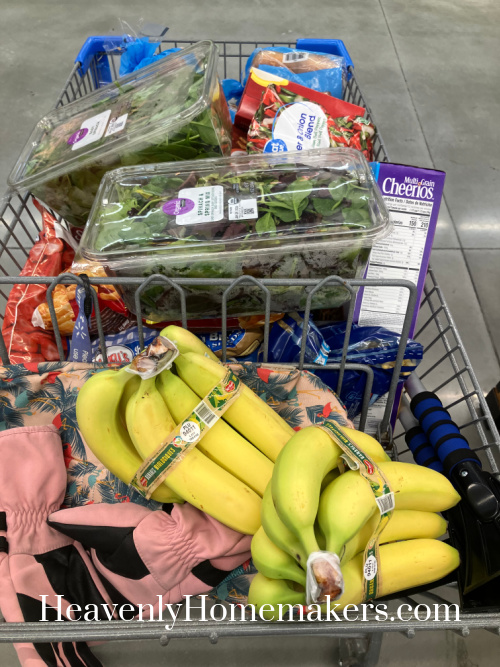
7. I only buy organic if it fits into the budget.
I used to overthink this and feel guilty. But God has taken this guilt away though because He’s taught me that loving people is much more important than obsessing over food.
Yes, I want to take good care of our bodies. I absolutely try to fill us all with nourishing foods every day. But my focus is more on meeting our kids’ emotional needs than worrying over an organic label on our food.
We also want to continue to fill our home and tables with dear friends who join us for meals frequently. We want to feed our guests well, but spending extra to be sure everything is organic would not work for our budget. I won’t trade an organic label for inviting people into our home to share our food.
I’m thankful that many organic foods DON’T cost more – like apples, spinach, mixed greens, salsa, pasta sauce, and carrots. I get them regularly and other organic items if I can. But if I buy pears that aren’t organic, I’m no longer worried. We’re still eating pears. Pears are healthy. God takes care of the rest.
8. We always eat at home or pack food if we’re on the road.
Buying restaurant food is not an option for us right now, and we are very ok with that. ( Think eating out would double our grocery budget. Plus can you imagine taking this many high-need kids into a restaurant? Phew.)
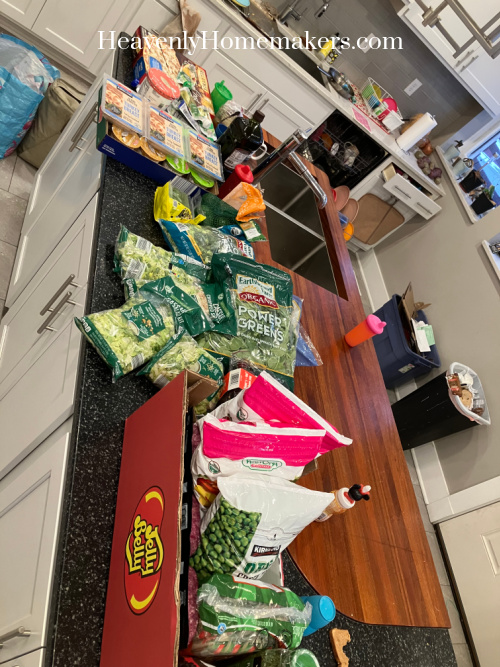
Instead, we’ve found all kinds of other ways to make food fun, to offer all of us treats, and to even pretend we are having fast food. (Bulk bags of chicken nuggets and fries from Costco are crazy cheap compared to feeding 13 people at Wendy’s – and they taste better too.)
I’ve found so many ways to make food prep simple that I never feel like I want to order take-out. If I ever need a night off from cooking (which, of course, I do), we bake Costco frozen pizzas. They are super cheap compared to ordering pizza and we love how they taste.
Costco or Sam’s $5 Rotisserie Chicken is also a great fast food option that goes a long way!

Exception to never eating out: There are a few times each year that we find ourselves on the road with the need to stop and get a bunch of McDonald’s nuggets or something like this. We aren’t legalistic about not eating out. We just choose not to most of the time and enjoy coming up with all kinds of other fun options to eat or pack instead!
9. We eat leftovers.
I mentioned above that we don’t like it when food goes to waste. Therefore, we put all of our leftovers from meals into our fridge to warm up another time. Matt and I are stay at home /work from home parents, and we almost always warm up leftovers for our lunch. Elias often packs leftovers to take to work for lunch. And whenever our fridge starts to get over full, instead of cooking something new, we have a meal in which we pull out all the leftovers and warm them up for people to help themselves to whatever sounds good.
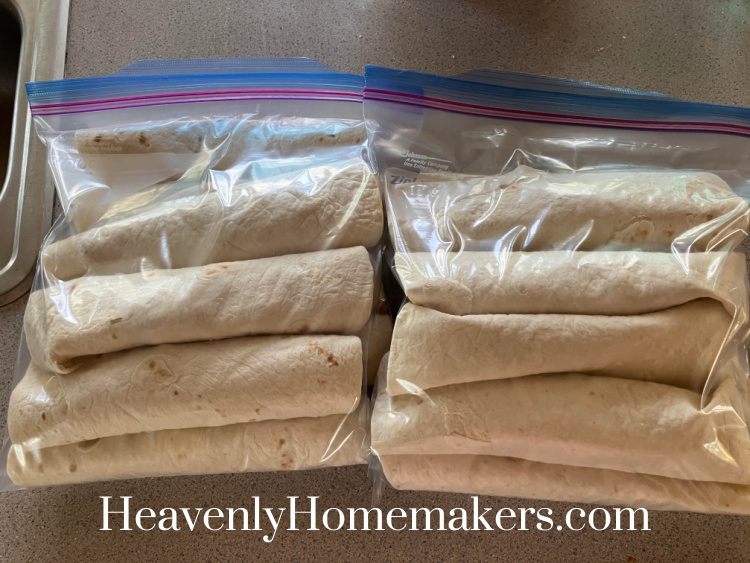
I’ve also found creative ways to turn leftover food into a brand new meal: like turning a Taco Bar into a casserole or a bunch of burritos for the freezer, taking leftover ham to make Ham and Potato Casserole or Breakfast Casserole. It’s pretty easy to turn leftovers into something new.
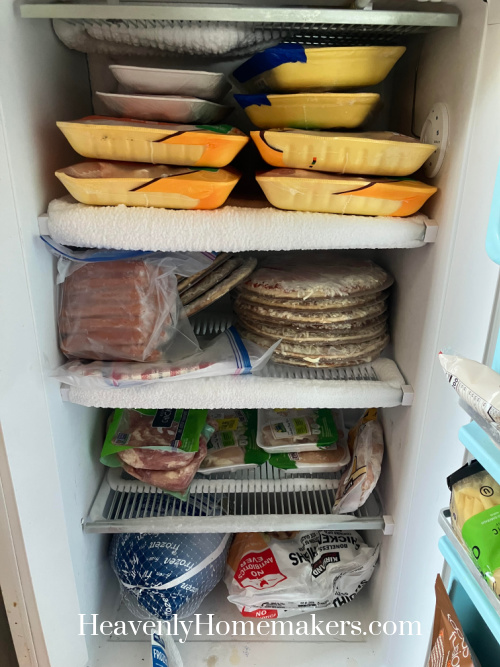
10. I make good use of our freezers.
If there’s a good sale (or a good deal on meat, as if I haven’t talked about that enough, ha), I stock up and fill the freezer. If I’m making one casserole or batch of muffins, I often make two or three while I’m at it to get more meals prepped for the same amount of work. I put the extras into the freezer for a convenient fast food another day. Frozen casseroles/muffins/breads also give me the option of providing others with meals if I find out of a need – a sick friend, a new mama, or a hurting friend.
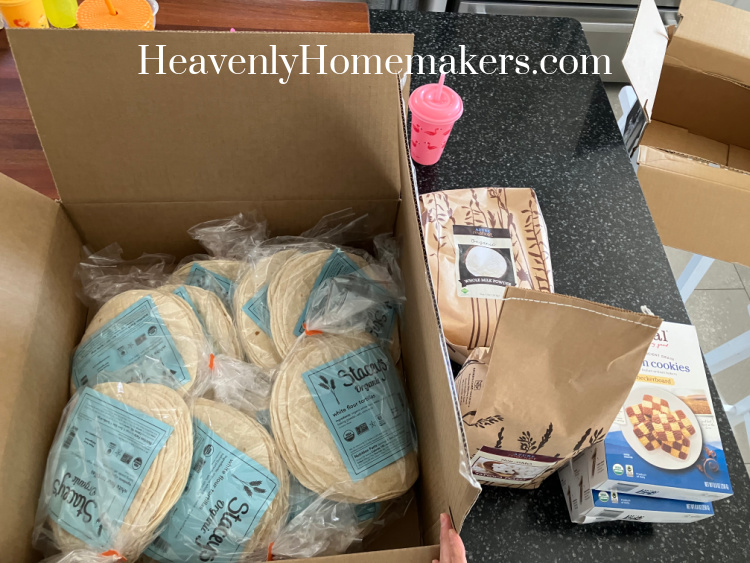
11. I use credit for Azure Standard purchases.
This is only worth a tiny mention as it doesn’t affect our budget much. But I do accrue a small amount of referral credit to Azure Standard when any of you sign up for an account and/or take advantage of what Azure has to offer. About twice a year, the credit number adds up to enough for me to put in an order that is mostly covered by the credit. Their food is great and some of it I can only find through Azure, so these are the items I stock up on when I can!
Our grocery spending for 2025
Stay tuned for our weekly posts to see what we’re eating and who we’re feeding. And watch for our monthly posts sharing what we buy and how much we spend. We’ll see if our monthly $1,400/month budget holds!
What are the best ways you’ve found to save money at the grocery stores where you live?

That is a very good budget for the amount of people you feed. Do you use a separate budget for nonfood household items and needs or is it included. I have a family of 7 children (3 teens) and two adults. I am working keeping ours down and having more fruits and vegetables. My younger children tend to go through fruit in one day it seems like a bag of mandarins for instance. We are also a neurodivergent family. God Bless!
I have the same question as the commenter above. Are things like diapers/pull-ups, wipes, paper towels, toilet paper, detergent, soap, hygiene products, etc., included in the $1400 budget? Because if they are, I am living in a different universe. ?
Nope! Sorry I didn’t answer above. This number is ONLY FOOD. Diapers, paper products, hygiene products, cleaners, supplements – all a different budget item. :)
Keeping a big family’s grocery budget low is all about planning and smart shopping! Buying in bulk, meal prepping, and sticking to a list can save big. Simple strategies for feeding a family without breaking the bank.
So inspiring to see how you manage a big family grocery budget so well! Practical tips that really show how planning and discipline can lead to big savings.
Hi Laura, thanks for sharing your methods for keeping your big family’s grocery budget low! It’s truly impressive how you manage to feed 12 people, soon to be 13 (6 adults, 7 kids), on a $1,400 monthly budget. Your strategies like finding meat markdowns, shopping in bulk, and knowing which items are cheapest at different stores like Aldi, Walmart, Sam’s, and Costco are clearly effective.
Reading about your multi-store approach and careful planning, I thought of an app called CartJedi. It’s designed to help shoppers track their spending while they are shopping in the supermarket, adding items to their cart. It might be a useful tool alongside your current system to monitor your spending against your budget as you move between stores, before you even reach the checkout.
Just a quick thought! Thanks again for the great tips.